how to build an effective strategy
Last modified on August 2, 2021
SEO is a rigorous work process that is synonymous with discipline, perseverance and patience. Implementing a strategy is therefore essential if you want to get results and be visible in Google’s results pages. Whether it’s a showcase site, an e-commerce site or a blog, I will give you the steps to follow to succeed in your SEO strategy effectively.
Step 1: Find Keyword Opportunities
The first step in an SEO strategy is to analyze the type of searches your target performs and what are the best keywords on which to position your website.
Keyword Generators
In order to choose your keywords, you can use different free and paid generators.

Example of keyword ideas in the “glasses” theme with the Ubersuggest tool
Spying on your competitors
One of the most effective ways to find out which keywords are getting the most traffic is to analyze your competitors. You may be able to get new ideas and keywords that you never thought of.
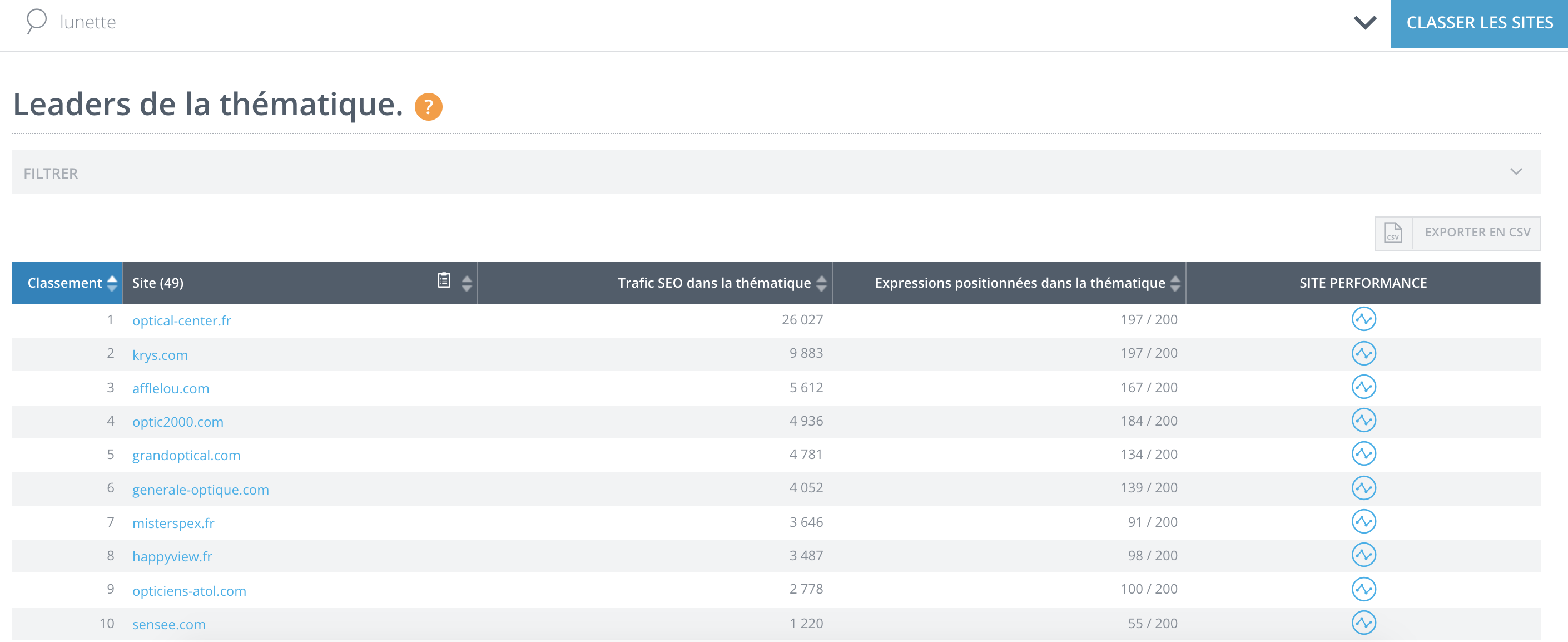
With Yooda Insight, it is possible to identify the main leaders in your theme and then analyze their SEO performance.
Betting on the long tail
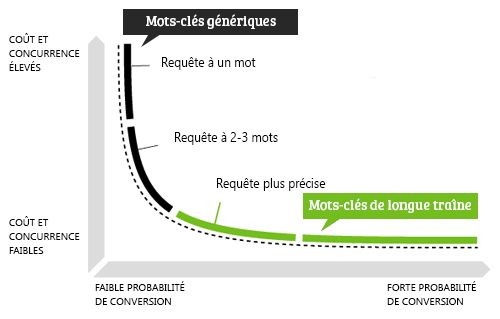
A common mistake in many SEO strategies is to settle for generic keywords that are highly searched by Internet users. However, you should know that high search volume queries are generally the most competitive and the least qualified. They are also the most difficult to reach, especially if you have a site with little notoriety.
One solution is therefore to focus your strategy on long tail keywords that are composed of at least 4 words. Although they are less sought after, they have the advantage of being more precise and less competitive. This is therefore easier traffic to obtain that will bring a very good conversion rate if the work is done well.
Step 2: Analyze the first page of the keywords you are targeting
After having established an initial list of keywords, you now need to understand how to position yourself on them. This step is unfortunately too often overlooked but is nevertheless essential to avoid working for nothing.
First, you need to understand the user’s intention and how Google interprets it. For example, with the query “glasses for screen”, Google manages to make the connection with anti-blue light glasses which is the answer to the user’s problem. Thus, if you want to hope to position yourself on this query, you will have to build your page in such a way as to be optimized for both the term “glasses for screen” and “anti-blue light glasses” which are close at the lexical level.

It is often said that a page corresponds to a keyword. In reality, it is necessary to understand that a page is equal to a set of keywords that are close at the semantic level. So be careful not to make several pages that can be redundant.
The other advantage of analyzing our keywords is to study how competitors manage to position themselves on them. The goal is to understand how the structure of the pages works, what is the ideal number of words, what are the tags used, what terms come up most often, etc. All these elements will be useful to us when we are going to make the content of our pages.
Step 3: Establish an action plan
You can’t expect great results if you don’t plan your strategy and are willing to invest the time it takes. So it’s essential that you get organized by developing a plan with all the keywords you want to target with your site and how they will be handled.
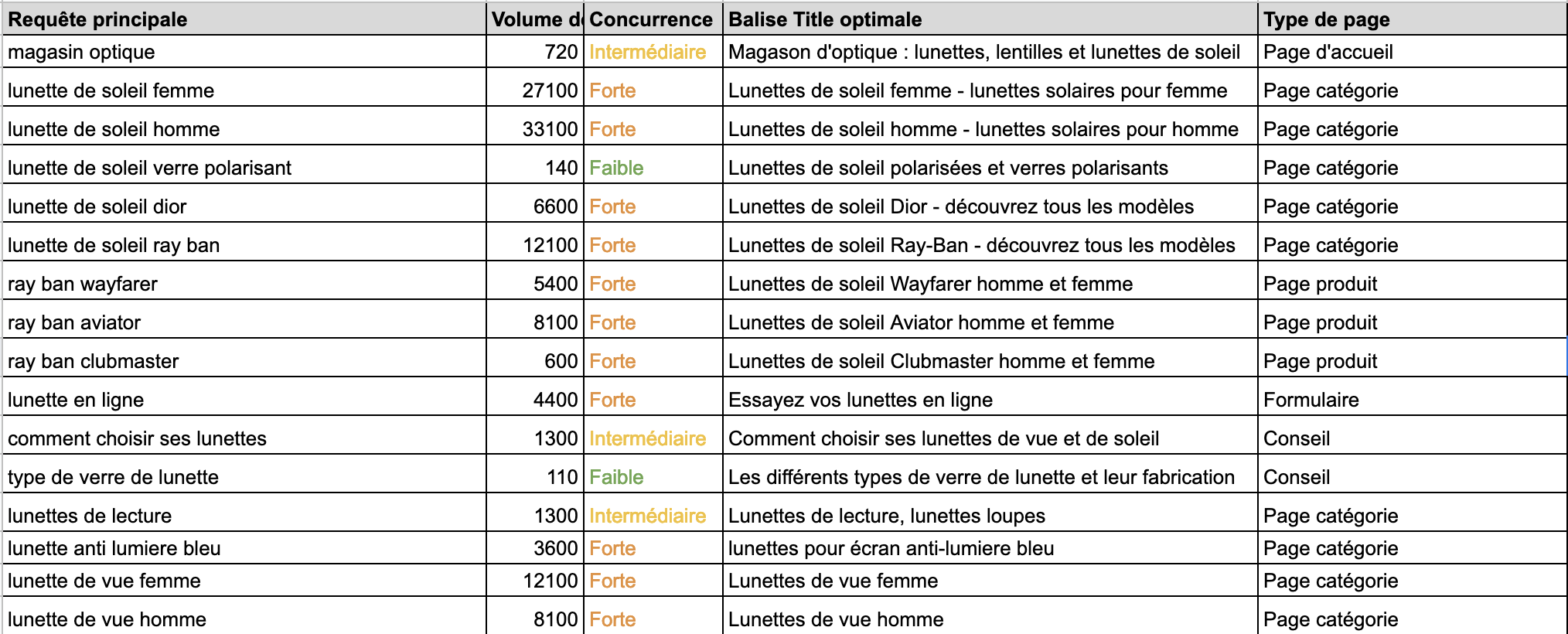
To do this, the ideal is to start by using a spreadsheet where you take your main keywords. A good rule to follow to facilitate your work is to organize the keywords by category and in order of importance.
Step 4: Optimize the content
Content is the raw material of SEO. It must be useful and respond as relevantly as possible to the Internet user’s query while being well optimized in order to be understood by Google.
Write relevant content
Think about how you can help your target audience by writing well-crafted content with tips and examples. Again, look at what works on the first page of Google to help you make the ideal plan, even if you delegate your writing. The aim of the game is to do better than existing competitors by drawing inspiration from good ideas to produce even more relevant content and, above all, by providing your added value. Several studies show that the most polished articles tend to have better SEO results. So don’t hesitate to create long and comprehensive content.
On-page optimizations
All pages on your site must be properly tagged to be well understood by Google. This is called “on-page SEO”. Here are the main optimizations to make:
- Specify unique Title tags based on your keywords
- Fill in the meta description to attract Internet users
- Structure the H1, H2, H3 tags…
- Add alt tags for images
- Have well-spaced and correctly formatted paragraphs (lists, tables, etc.)
Step 5: Create a coherent internal mesh
The more content you have, the more important it will be to build an internal mesh in order to establish the architecture of your site. The goal is to link your content with other pages and articles on your site that provide real added value to your readers. You must therefore think about your site in a global way and anticipate how one page can be complementary to another.
Beyond structural links (menus, breadcrumbs, footers, etc.), the links that offer the most power are contextual links placed within a text. The deeper the links are, the better the internal meshing. You must therefore ensure that your pages are linked to other pages of the same level and/or lower level.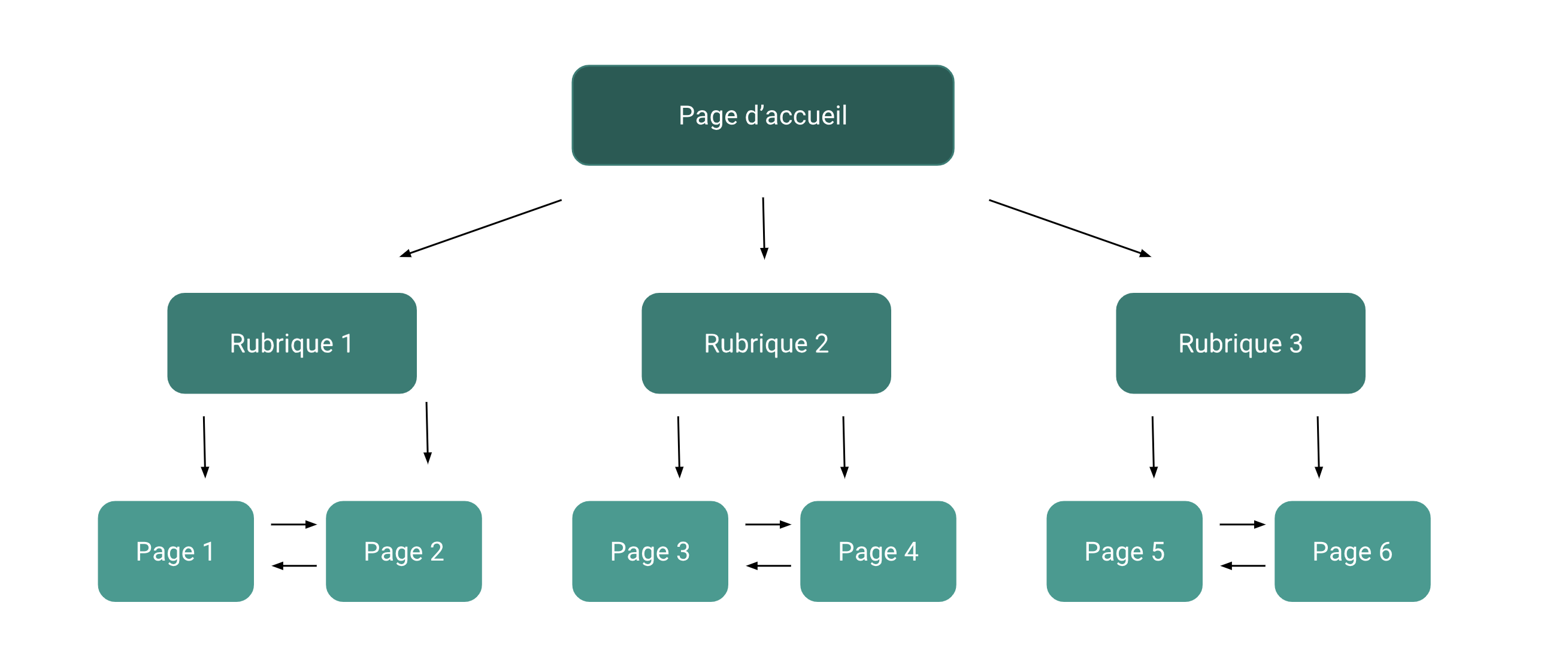
Step 6: Get External Links
Along with content, site popularity is one of the main criteria for ranking well on Google. In SEO, popularity is simply the quantity and, above all, the quality of external links that point to your site.
What criteria should you use to build your link strategy?
There are several criteria to take into account when evaluating a good link:
- It must come from a site with a similar or related theme to yours
- It must be placed in context (inside a paragraph of content)
- The page where your link is located must not be saturated with too many other outgoing links (links in the footer or on partner pages will have little weight)
- Have an optimized anchor on a minority of links. Instead, favor a varied link profile
- It must be dofollow (which is, for example, not always the case for links in blog and forum comments)
Netlinking is a mandatory step but unfortunately, it is not easy. There are several techniques to obtain your precious links. Here are a few.
- Directories (use sparingly)
- Item exchanges (making triangular and non-reciprocal exchanges)
- Go through platforms that connect advertisers and publishers
- Conduct a linkbaiting campaign
- etc.
Step 7: Continuously analyze and optimize
To analyze, optimize and check the status of your site in search engines, the first tool to use is Google Search Console which is free. It shows you all the errors that Google finds on your website in order to resolve them quickly. In the same way, I advise you to connect your site to Google Analytics to analyze all your traffic such as the number of sessions, traffic by channel, new users and returning users or the total number of conversions.
Finally, tracking positions on the main keywords seems essential to me. This allows you to follow the progress of your pages in search engine results. If some of them stagnate or even regress, this will allow you to make the right decisions.

Passionate about the web and entrepreneurship, I founded Digitiz in 2016. My goal is to share my experience with you and save you time in choosing your tools.
Similar articles