How to correctly outsource e-commerce site development
Last modified July 18, 2021
Across the globe, the e-commerce space has continued to grow at an unprecedented pace, with people from all walks of life preferring to shop from different online stores.
Unlike brick-and-mortar stores, online stores offer shoppers the convenience of shopping from home while allowing them to save time that would otherwise have been spent waiting in checkout lines. That said, the process of developing an e-commerce store can be difficult, especially if you have no idea where to start. Fortunately, you can hire Ukrainian developers to help you create your website in France.
What is web development outsourcing?
Outsourcing is a business practice of outsourcing web development services to a third party. In web development, an outsourcing initiative can range from developing an entire website to more discrete functions like troubleshooting and disaster recovery.

Source: Statista
According to a 2019 Statista report, the global IT outsourcing market is estimated at $92.5 million, and it is expected to grow 5% annually to reach $98 billion by 2024.
Source: emarketer
This huge growth has put increasing pressure on businesses to launch their stores online. Website development companies, on the other hand, have also faced increasing pressure to adopt the latest technologies to ensure that their solutions meet the needs of this growing business sector.
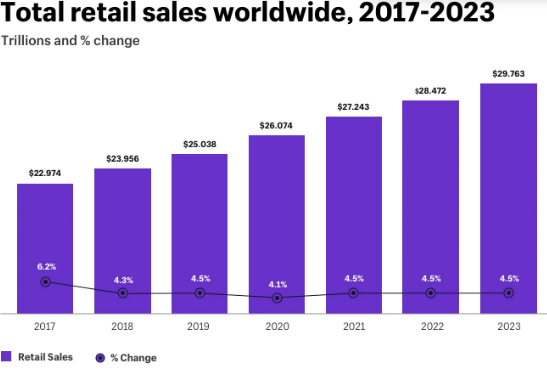
In 2019, for example, global e-commerce sales reached $3.5 trillion, and this amount is expected to nearly double by 2023 to $6.5 billion.
When it comes to e-commerce website development costs, there is no one-size-fits-all price. In fact, it can range from $5,000 to over $5 million, depending on the size, complexity, and platform. And even when your website is finished, you will continue to invest more money to improve the user experience and functionality of your online store.
That said, the closer you get to a conclusive average cost for developing an e-commerce site, the more you will need to consider various aspects such as the type of e-commerce platforms, tools, add-ons and level of customization.
Different Ways to Outsource Website Development
Your business can choose to hire a coder in-country or hire a team of developers nearby from a neighboring country, or even work with independent developers remotely, depending on your budget or project needs.
Here are some of the most popular methods:
Subcontracting
Outsourcing involves hiring a team of qualified web developers working remotely to work on your project under your supervision. In addition to monitoring the workflow and productivity of your remote programmers, the team also collaborates with your internal developers to strengthen your project.
On the other hand, the outsourcing development company takes responsibility for hiring, administration, and other resources.
Outsourcing agency
Outsourcing is the business process of hiring a company to build a custom e-commerce website based on your needs. The development partner is responsible for everything, including the progress of the project, management, equipment and salary of the development team. You simply need to focus on your core business activities and your website will be delivered ready for deployment.
Freelancers
Independent ecommerce website developers typically work alone, and they are more flexible than outsourcing and outsourcing agencies.
| Benefits | Disadvantages | |
| Subcontracting |
|
|
| Outsourcing Agency |
|
|
| Freelancers |
|
7 Tips for Successfully Outsourcing Website Development
Know your business needs and goals
Before you even consider hiring an e-commerce team, the first thing to do is to make a list of your business needs, project needs, and a rough concept of your online store design.
Finding the Right Web Development Service Provider
Once you have defined and analyzed all your business and technical needs, the next thing to do is to choose the right website outsourcing provider. You can start your search on platforms like GoodFirms, Manifest, Clutch.co, etc. You can also choose to hire developers from Ukraine, which is one of the best countries to find top-notch offshore development teams.
To ask questions
Development projects involve a lot of technical terms that may be unfamiliar to you, especially if you don’t have development experience. Therefore, if you come across something you don’t understand, don’t hesitate to ask for a brief explanation.
Communication is essential
In any development project, constant communication is essential because it helps get your ideas across and keeps everyone on the team in the loop. This is why you need to establish standard communication channels from the start.
Have a project manager
As a project owner, it is important to have a project manager to manage your project. Not only does he make sure everyone is informed, but he also oversees all the moving parts of the project.
Divide the project into small tasks
Today, most development teams use the agile development process. It involves dividing a large project into small parts and phases, which development teams can work on quickly. As the project owner, this model works great for controlling payments, since you have to pay once a certain milestone has been reached.
Write a contract
If you want unwavering commitment when building your e-commerce site, it is strongly recommended to draw up a contract. This will eliminate legal uncertainties and ensure that your project will be delivered as agreed and at the agreed time.
The future of e-commerce development
Constantly evolving consumer behaviors and the growing ubiquity of mobile device usage make the future of e-commerce development exciting to say the least. In 2020, mobile devices accounted for $175.4 billion in e-commerce revenue. This means that more and more online store owners will be forced to annex user-friendly mobile checkouts to tap this vast market. Other technologies on the horizon include voice commerce, augmented reality and online experiences.
Most Fortune 500 companies, including IBM and Samsung, are increasingly choosing to outsource their web development projects. As a small business owner, it would not be reasonable for you to continue looking for web development teams in your geographic area.

Passionate about the web and entrepreneurship, I founded Digitiz in 2016. My goal is to pass on my experience to you and to be able to save you time in choosing your tools.
Similar articles



![[SEO] Qualifying your link opportunities: best practices](https://davidreyero.es/wp-content/uploads/2023/10/obtenir-backlinks-seo-ledigitalizeur-1-1-768x432.jpg)