The omnichannel customer journey enriches the customer experience
Last modified on June 28, 2023
A major trend in 2020 that will continue into 2021, designing effective customer journeys has become the key to successful Digital Marketing Strategies.
In the galaxy of Digital Marketing books that address the subject, “Everyone can make their own customers” by Christophe MENANI has a special place; the book offers a solid, step-by-step and iterative method for thinking of an implacable strategy with the promise of creating customers (and not looking for them).
Here is an excerpt from the book that addresses the subject of Omnichannel and which already proposes a way of modeling that will interest you.
“If you frequent a local coffee shop, for example, the servers know you personally. They might even have your coffee prepared exactly the way you like it when you walk up to the counter.Why isn’t this happening online? Why can’t we help businesses recreate that warm, easy feeling online? Neil PATEL – Successful web entrepreneur
Increasingly, the web seeks to recreate the warmth and personalization of traditional business relationships, even human relationships. To do this, the main idea is to be able to organize the right points of contact, at the right times and on the right channels.
Omnichannel offers the possibility of setting up adapted and efficient customer journeys, based on the behavior of your targets. Let’s see together how…
- Omnichannel vs Cross Channel vs Multi Channel
- Omnichannel in Real Life and Roger’s Story
- Can we draw this route? (Spoiler: YES!)
- Let’s decipher Roger’s journey
Omnichannel vs Cross channel vs Multi Channel
In digital, one buzzword chases another and the impression is set in that new concepts chase away old ones. In reality, concepts evolve and change names, which provides an opportunity to promote new “disruptive paradigms!”
In the field of customer journeys, if we query Google Trends, it seems that the trend is towards the term “omnichannel”.
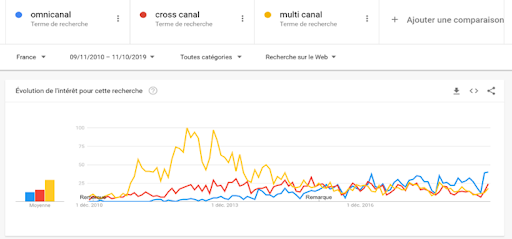
That said, in real life, this semantic progression accompanies an evolution in the behavior of customers and brands:
Multichannel
The era of multichannel was the one where brands understood that they needed to invest in all digital territories: a website, social networks… Multichannel is a tactic for occupying the field.
Cross Canal
The objective of Cross Canal is to take advantage of this presence on all terrains to create bridges from one to the other. Several tactics have been developed to take advantage of these complementarities:
- Click and collect : first launched by the company Argos in the early 2000s, click and collect is a service offered to consumers allowing them to reserve or order products online before collecting them directly from a store.
- The web2store is a tactic that aims to work on your website in order to get visitors to move to your store and generate traffic in your physical store.
- The ROPO (for Search Online and Pay Offline) is a Search Marketing tactic that aims to direct the flow of Google searchers to your physical store.
You understand that cross-channel tactics are initiatives you can take to leverage your presence both online and offline.
Omnichannel
82% of shoppers use their phones to help them make a decision about an in-store purchase. (Source: Timb Design)
The web started talking about omnichannel around 2015, when the concept of omniconsumer was identified. It was then observed that customers were themselves active on many channels and above all that they chose the one on which they wanted to get in touch with you, in what context and at what time.
Omnichannel strategies seek to understand consumer behavior and continuously adapt to it to offer a simple, exciting and, above all, seamless experience.
Omnichannel IRL (in real life!)
As an illustration, here is Roger. He is an executive in a bank in La Défense. Here is his day.
Roger consults the FNAC.com website in the morning on the metro. He lingers over the details of a television.
- He is interrupted by a network outage and loses track of his research.
- When he gets to the office, he checks LinkedIn like every morning and sees an ad that invites him to go back to the TV presentation page. It’s not the right time for him; he doesn’t go.
- During the break, when he enters the shopping center for lunch, he receives a text message from the Fnac salesman who offers him a slot. Roger does not follow up, has lunch, works and goes home.
- The day after tomorrow, he receives a letter in his mailbox with a special “Televisions” discount voucher, limited in time. Roger is motivated by this offer and decides to take advantage of the discount immediately.
This example is of course fictitious: Fnac did not set up this scenario precisely (and Roger does not exist!).
You have all already experienced this kind of process, which is quite simple to design and always felt a little intrusive by many people. When Roger entered the Fnac.com site, he integrated a conversion funnel which aims to lead him to make a purchasing decision.
Let’s go through the scenario step by step to identify the marketing levers used:
| No | Funnel Stages | Channel used | Content |
| 1 | Roger consults the FNAC.com website in the morning on the metro.
He lingers over the plug of a television. |
The fnac.com website | Product sheet |
| 2 | When he gets to the office, he checks LinkedIn like every morning and sees an ad that invites him to go back to the TV presentation page. It’s not the right time for him, so he doesn’t go. | LinkedIn Retargeting | Proposal for a demonstration meeting |
| 3 | During the break, when he enters the shopping center for lunch, he receives a text message from the Fnac salesman who offers him a slot.
Roger does not follow up. |
SMS geofencing | Relaunch of the RdV proposal |
| 4 | The day after tomorrow, he received a letter in his mailbox with a special “Televisions” discount voucher, limited in time. | Retargeting by email | Limited Time Coupon |
| 5 | Roger is motivated by this offer and decides to take advantage of the discount immediately. | Checkout | Ordering with discount |
Can we draw this route?
Yes! We even have to do it!
When you put a sales site online, the normal customer journey might be as follows:
- The visitor arrives on a product page.
- He is convinced and adds the product to his cart.
- Eventually he will look at other products.
- He goes to his basket and confirms the order.
- He then enters his delivery and payment information.
- He validates.
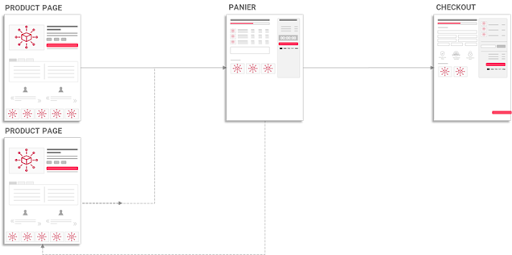
That’s what you want! In reality, there are many risks of losing visitors at each stage. They may leave the product page before adding to the cart, never validate the cart, not validate the payment …
What Fnac is putting in place in this example are actions to support Roger on his journey, to help him move from one stage to the next and to catch him when he strays from the path.
This funnel might look like this:
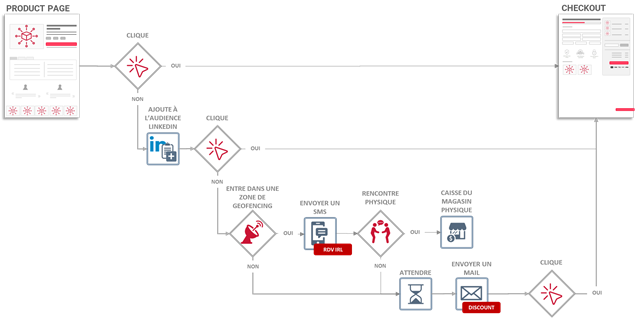
In Roger’s case, the role of the funnel is to notice that Roger has exited the course prematurely and to bring him back into it through the use of gradual actions.
Let’s decipher Roger’s customer journey
We will detail all the channels and content used here in the rest of this document; for the moment, let’s note several elements that will be structuring for the rest.
Note 1: Roger is already in an active research phase.
When Roger enters this mechanic, he has just spent time on a product sheet. He is therefore actively looking for a TV screen. The channels and content used here are adapted to this state of mind.
Note 1: Roger is already in an active research phase.
When Roger enters this mechanic, he has just spent time on a product sheet. He is therefore actively looking for a TV screen. The channels and content used here are adapted to this state of mind.
Note 2: This is not SPAM!
Roger was previously convinced:
- That he needed a new TV
- That Fnac could meet his needs
- That this TV was a good solution for him
In this scenario, the messages are personalized and relevant to the context Roger is in. So there is little chance that he will find the communication intrusive or consider these signals to be spam.
As a reminder, spam has nothing to do with the frequency of sending messages. If I send you an envelope containing €500 every day by post, you will not consider yourself receiving spam (despite a large number of messages).
Note 3: there is a trick…
The Fnac salesperson did not send a text message… He is not even necessarily aware that an invitation has been sent and that he has started a conversation with Roger. The sending of the message, the programming of a LinkedIn retargeting campaign as well as the sending of retargeting emails were programmed and executed automatically by a Market Automation robot.
Note 4: Be everywhere to be in the right places.
Why did Fnac choose to send the retargeting message on the LinkedIn site?
In reality, she didn’t choose! She simply programmed her marketing tool so that visitors to the product pages are registered in a list of prospects interested in TVs and she has a display campaign in place continuously that targets this list of prospects with an adapted message (in this case, the right TV).
In fact, if Roger had opened Facebook early in the morning, he would have seen the ad there too.
Note 5: Phygital
Finally, note that this scenario combines marketing tools (advertising, etc.), commercial tools (the seller), online tools (the website) and offline tools (the store).
This scenario is referred to as phygital (for physical + digital) and allows us to illustrate the need to go beyond the web and use all available channels to support your customers’ choices.
Last thing : the main purpose of this process is to support Roger and convince him to move from the information search stage to the decision-making stage. We seek to mature his conviction and help him move forward in his journey.
We can therefore understand that this customer journey is the path that Roger takes between the moment when he does not plan to buy a TV until the moment when he buys the TV he has chosen.
The whole art of customer journeys, funnels and digital marketing strategies is to understand:
- What intermediate states does Roger go through in his maturation process?
- What does Roger need at each stage of his journey?
- How can we help Roger progress and take him to the next level?
- How to continuously monitor and improve the entire process?

Passionate about the web and entrepreneurship, I founded Digitiz in 2016. My goal is to share my experience with you and save you time in choosing your tools.
Similar articles