

Last modified on August 4, 2021
The tree structure of a site is a problem that comes up regularly before the design or redesign of a website. In this article, I would like to share with you my feedback on creating a high-performance site structure. The advice below will help you, I hope, to have a site that really meets the needs of your users, and that offers better results for your visibility on Google. Follow the guide !
Why should a website tree be well organized?
I have often been surprised to see how much site structure is most often neglected. Yet, it is one of the most crucial aspects of a site’s performance whether in terms of SEO or business.
Better user experience
The tree structure of your site allows you to have an overall view of the navigation path but must above all be a reflection of what you offer to visitors. Ultimately, it’s like when you browse the menu in the front of a restaurant. If it doesn’t appeal to you, you move on to the next restaurant. For a website, remember that it’s exactly the same: if your navigation menu doesn’t speak to your visitor, regardless of the destination page, they will return to Google and move on to the next site.
A well-thought-out and optimized site structure can reduce bounce rates and improve the time spent on your site – which is also a factor in search engine ranking.
Better visibility on search engines
Crawlers like Googlebot browse millions of sites and pages every day. Their goal is to index content and then rank it in search results according to its relevance. The better the structure of your site, the better the indexing of your pages will be. Indeed, Google cannot crawl everything. This is why having a well-built site that also includes a sitemap will facilitate the exploration and indexing of your content.
Similarly, Google’s algorithm automatically assigns sitelinks based on your browsing. A real plus in terms of conversion on clicks via Google if your site is well optimized.
Online tools for creating a tree structure
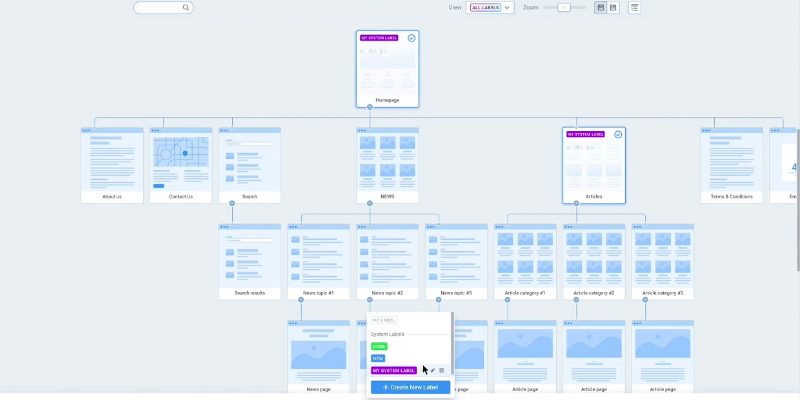
FlowMapp
FlowMapp is an online tool for creating visual sitemaps and user flows to help design and plan the user experience.
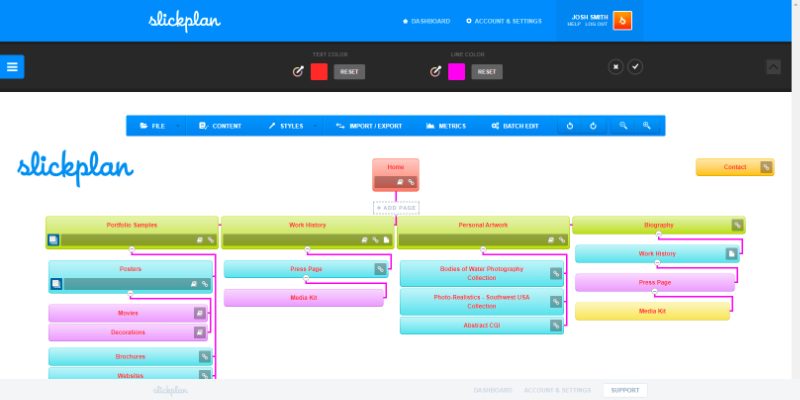
SlickPlan
SlickPlan also allows you to create tree structures and makes teamwork possible. A remarkable feature of the tool is its ability to customize each element.
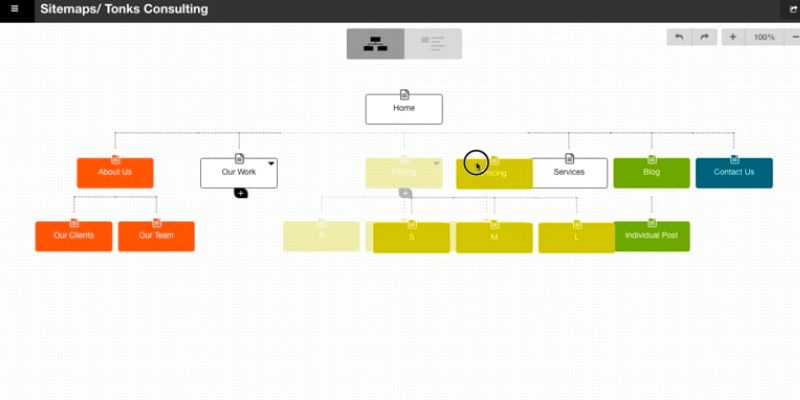
WriteMaps
WriteMaps has an intuitive interface and allows you to create up to three trees for free. Like other tools mentioned above, WriteMaps also supports customizing sitemap colors.
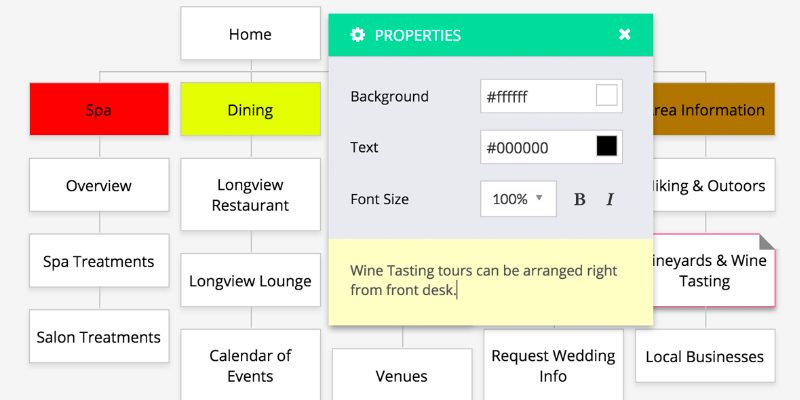
GlooMaps
Gloomaps is one of the simplest tools for creating a site tree. Although its features are not very advanced, it can satisfy the needs of small projects.
Steps to creating a website structure
Creating your website’s tree structure is often a very delicate exercise. By following a certain number of steps, you will have a better chance of having a high-performance site.
1. Analysis is the beginning of success
If you are in the process of redesigning your existing site, it is essential to do a analysis of your statistics (number of visits to your pages, bounce rate, visit time, etc.) in order to have initial elements of response on the dysfunctions. It may also be interesting to cross-reference this data with a Heatmap tool like Hotjar (freemium). This will allow you to push your analysis even further:

If you don’t have a website yet, benchmarking competitor sites will give you some ideas for best practices in your sector. Obviously, it’s not about doing the same thing, but rather taking inspiration from those who are well positioned in search engines and projecting yourself based on your differentiations.
2. Build your site for your users
Engage with your users to better understand their needs, behaviors, and motivations. This will help you build your personas and determine the optimal user journey based on your desired goals.
The simplest way is to define scenarios and identify for each of your personas the path taken on the site. We will define a persona based on several non-exhaustive characteristics.
- His profile (his demographic data and his typical biography)
- His needs and objectives
- His brakes
- Its user journey
- Its typology
So, each persona will have their own defined journey with an acquisition channel and a landing page different from the other personas. Remember that the majority of your visitors do not arrive via your home page. Hence the importance of anticipating as many scenarios as possible to improve your conversion rate.
3. Take inventory of your content
Before designing or redesigning the site architecture. Take stock of all your content, making sure it is relevant to users and can be optimized. If you think you don’t have enough, can you produce it yourself? In which case, keep some budget to possibly call on a web editor for your future content.
Be careful though if you want to do a redesign and clean up your content. It is very important to weigh the potential damage to your SEO. Don’t forget to do 301 redirects to your new pages so as not to lose the work that has been done.
4. Make a draft of your tree structure
Once you have identified the content of your site, it is recommended to diagram how your pages will be hierarchical and associated with each other.
To be honest, there is no universal method. You can do it on paper for a simple structure or on a spreadsheet like Excel or Google Drive for a more complex structure. Some also prefer mind mapping software. Powerpoint can also do the trick very well for those who are old school.
The important thing is to keep a tree structure logic to better organize your information in a coherent way while remaining as simple as possible. However, avoid having too many levels in order to facilitate the crawling of search engines and to avoid having orphan pages. Each subcategory must somehow be attached to the main category in which it is located.
5. Optimize your tree structure for SEO
The tree structure of your website will have a significant impact on your natural referencing. Indeed, search engines analyze your content but also the links between pages to determine their rankings and determine which are the key pages. This is why it is very important to organize your content according to their semantic field in order to tell Google what you are talking about.
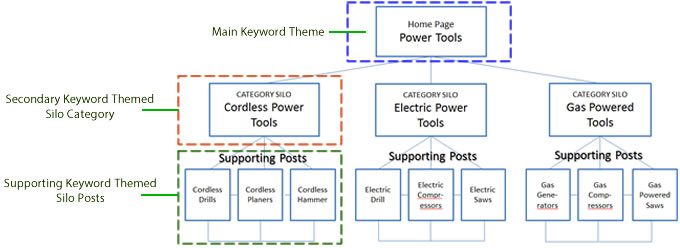
To maximize your chances of positioning your pages well, you can build a silo architecture. That is to say, all the pages of a given category belong to the same semantic field and are linked by contextualized links to your content.
Example of a silo tree:
Other factors can also help improve the performance of your site architecture:
A URL structure that is not too long
It is important to keep in mind that your URL is one of the many SEO criteria and that it must contain your keywords. To be SEO friendly, there are therefore two possible options:
- Your URL structure will be organized according to the hierarchy of your site (eg: mysite.com/category/subject/my-page). This may be possible if you do not have many categories (3-4 maximum). Be careful though because it is strongly recommended not to exceed 75 characters in the length of your URLs.
- You have many categories and subcategories. It would therefore be wiser to personalize your URL as Amazon does for example where we find the denomination and the name of the product:

Note that the product code is placed at the end to indicate to Google that it is not important to take into account.
A shallow navigation structure
Make sure that pages, especially important ones, are not buried too deep in the site. Sites with a shallow hierarchy perform better, both from a user journey perspective and for bot crawling.
An ideal site should require at most 3 clicks or less to access each page.
A well-balanced internal mesh
Internal and external links help spread what is called in SEO jargon “link juice”. It is therefore important to link your pages together with anchored and contextualized links in order to make them rise mutually in the search engine rankings. Note that the more links you have, the more the juice is diluted. So use a light hand when you create your linking to give more weight to your strategic pages.
If you want to know more, you can also read this article about SEO optimization.
To conclude
As we have seen, building your site tree structure still requires a bit of thought. However, it is worth it to be well understood by your users as well as by search engines. So take the time to do this step correctly before starting to design your site because you will surely save time later!

Passionate about the web and entrepreneurship, I founded Digitiz in 2016. My goal is to share my experience with you and save you time in choosing your tools.
Similar articles