How long does it take to be indexed and referenced on Google?
Last modified on July 29, 2021
When I present my SEO support services, a question comes up regularly “How long does it take to be referenced in Google?”. If there is no exact answer, I will try to provide answers regarding indexing and positioning times.
Google Indexing Delay
Before even asking the question of how long it takes to be on the first page of Google, it may be useful to review some of the basics of natural referencing. You must understand that it works in several phases and that it requires (very) patience.
The first step is the crawl of the site. Google robots will then read the HTML codes by going from one URL to another. Then there is the indexing part where the search engine will check if the page is valid to deserve to be in its database.
There is no standard time for indexing a page on Google. However, we generally notice times ranging from a few days to several weeks for a new website. If it is a question of indexing a page on a site that has existed for some time and is regularly updated, the indexing time will be much faster, i.e. a matter of a few hours (sometimes less).
There are several factors that can make it easier for a page to be indexed:
- The sitemap is populated in Search Console
- The site has some history
- The pages are correctly linked together
- The site benefits from external links (backlinks)
- The site is regularly updated
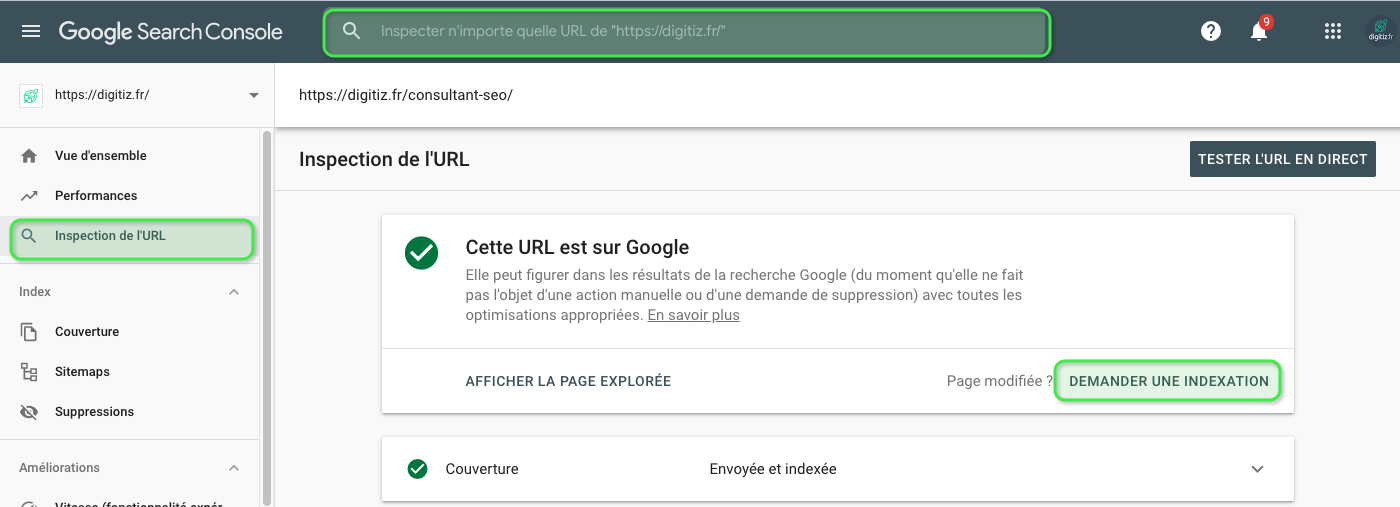
If you notice that after a certain time your page is still not indexed, you can then go to Google Search Console and go to the “URL Inspection” tab to then request indexing.
Once a page is indexed, the third step in SEO is positioning.
Positioning criteria
Pages that rank well in Google are selected into the index based on how well they match the search query. There is no exact formula for getting your website to the top of a Google search. However, the following factors play a key role in the ranking process:
- Have your own domain name: Google’s algorithm is designed to spot websites that try to cheat the system with tricks like keyword stuffing or buying inbound links. These ploys may work for a while. However, if Google catches on, your site will be penalized and your rankings will suffer.
- The age of the domain name: A web domain that is less than six months old is considered a “new” site in Google’s eyes. It is therefore considered less credible than an older website that has been thoroughly checked by Google’s algorithm.
- Keyword competition: The keywords or phrases you’re searching for are often highly competitive, and established sites in your industry have a head start on popular searches. If your site is new, it’ll be easier to try to rank for less competitive queries before moving on to more popular phrases.
- Content quality: Googlebots are designed to identify characteristics such as how often you publish new content, the originality of your content, and the length and overall quality of your content. Adding unique and high-quality content will help you rank higher over time.
- Incoming links: Whether internal links (internal meshing) or external links (backlinks), the latter have always had considerable weight in Google’s algorithm. It is preferable to obtain contextual links from credible sites and in a theme close to yours to maximize your chances of being well referenced.
How long does it take to be positioned on Google?
Let’s look at two concrete cases to analyze the positioning delay for a new domain name and an expired domain name.
For a new site
If you are starting from scratch with a new domain name, for example with your brand name, you will have to be patient before acquiring organic traffic on Google. Generally, there is a delay of from 6 months to 1 year before you start positioning yourself on competitive keywords.

For a site with an existing history
If you are lucky enough to have a site with some history, some SEO optimizations and the addition of quality content will help your pages rank higher. in just a few months.
In this example, a niche site was built from an expired domain name that had some history and thematic links. This allowed the site to quickly position itself on competitive queries.

Study on positioning time in computer graphics
Ahrefs did a study on “how long does it take to rank in Google”. While this study unfortunately doesn’t give an exact answer, it does at least show that nearly 95% of newly published pages don’t make it to the Top 10 within a year. Most of the “lucky” ones who do only make it to the Top 10 for about 2 to 6 months.
I’ll let you discover the results of this study through this infographic produced by The Website Group.

To conclude
In the end, SEO is mainly a matter of strategy and patience. It is completely normal to struggle at first, but with perseverance, you will be able to gain your first positions in Google’s results pages after a few months.

Passionate about the web and entrepreneurship, I founded Digitiz in 2016. My goal is to share my experience with you and save you time in choosing your tools.
Similar articles