everything you need to know
Last modified July 18, 2021
Account-Based Marketing (ABM) provides organizations with a significant return on investment (ROI) when it comes to acquiring, retaining and growing high-value accounts.
Although Account-Based Marketing (ABM) has been around for a while, some say dating back to the early 2000s, it has only recently taken off and been applied on a large scale in due to the introduction and development of new technologies.
While you’ve probably heard the phrase “Account-Based Marketing” many times, there is often some confusion about what it is, how it works, and, more importantly, whether it is an effective and cost-effective method for running B2B marketing and advertising campaigns. Let’s try to clarify this !
What is Account-Based Marketing?
Account-Based Marketing (ABM) is a business marketing strategy that focuses resources on a specific set of target accounts within a market. It uses personalized campaigns to engage each account, tailoring the marketing message to the account’s unique characteristics and needs.
A targeted approach to B2B marketing in which marketing and sales teams collaborate to target and convert the best-fit accounts into customers.
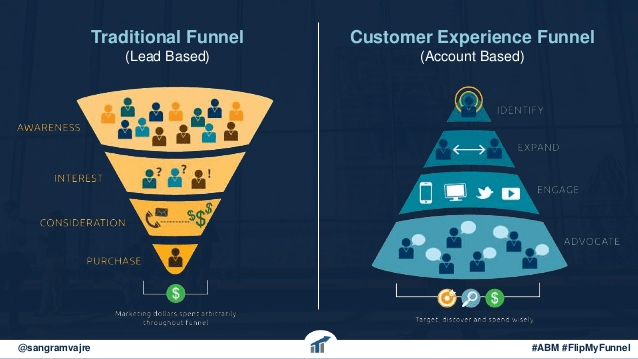
ABM also takes a broader view of marketing than just lead generation. One of the keys to getting the most value from your largest accounts is to market to existing customer accounts to encourage upselling and cross-selling.
Source: https://www.slideshare.net/sangramvajre/flipmyfunnel-with-accountbased-marketing
What are the advantages of Account-Based Marketing?
Now that we’ve covered the definition of Account-Based Marketing, let’s look at another essential question: what are the benefits of ABM?
Strong sales and marketing teams
Account-Based Marketing begins with your sales and marketing teams identifying and agreeing on target accounts. This means that both teams should be focused on the same goals, including generating revenue from target accounts. Above all, this demonstrates the essential role of marketing in the sales process.
No more traditional cold calling
Using Account-Based Marketing to reach target accounts positions your sales team for future success with their buyers. Buyers will have already been exposed to your company’s message by the time your sales representatives contact your target accounts.
Marketing budget effectiveness
With a lead-based strategy, businesses spend money on marketing to acquire as many leads as possible and then qualify them after acquisition, which amounts to wasting money on leads that aren’t a good fit ( or who are not qualified). It’s much more cost-effective to first determine which accounts are the best fit for your products or services, then spend your money reaching them (and only them) through the channels where they are active: on the web , on social media, at events, etc.
Reduced sales cycle
Multiple stakeholders are involved in important purchasing decisions. As it starts at a lower level of the organization and slowly moves towards the main decision maker, it usually slows down the sales process. Account-Based Marketing helps solve this problem by sending the right message to key decision-makers in target accounts who may not always be reachable by phone or email, shortening the sales cycle. The length of the cycle is reduced in Account-Based Marketing because all prospects are nurtured at the same time.
Improved customer service
Account-Based Marketing concerns above all the customer. As a business professional, you understand that buyers don’t wait for a sales call or marketing email to begin their research. Instead, they prefer to explore solutions on their own, receiving communications from vendors only when they are meaningful and relevant. Account selling makes it easy to meet this need throughout the buyer journey and customer lifecycle.
Effective time and resource management
Time and resources are spent on a small number of accounts that are most likely to result in sales. This frees up resources that would otherwise be wasted.
Increased return on investment
With Account-Based Marketing, you can easily calculate the return on investment (ROI) for each account in which you invest resources and time. This is useful because you can confirm whether the accounts you invested in were suitable for your business. Then, in the long term, you can nurture and delight these accounts, as well as identify and target similar accounts in the future. If your ROI demonstrates that your ABM tactics were effective, use these results as motivation to move your strategy forward, as well as something you can count on to continually improve your results.
A list of carefully selected, high-value accounts forms the basis of a successful ABM strategy. Once you’ve defined your goals, your marketing and sales teams can work together to create and deliver personalized campaigns through the most effective channels.
By implementing software or having a digital agency support your sales and marketing teams, you will be able to more effectively identify valuable accounts, reduce friction in your flywheel and develop yourself better.
However, here is a step-by-step guide to implementing Account-Based Marketing for your business.
Step 1: Identify and categorize your high value accounts
Use all available marketing and sales data to help you identify and prioritize your high-value accounts. Consider revenue potential as well as other strategic factors such as market influence, likelihood of repeat purchases, and the possibility of above-average profit margins.
Step 2: Identify key internal stakeholders and map accounts
Determine the structure of your target accounts, how decisions are made, and who the decision-makers and influencers are. Understand customer needs and pain points, as well as the status of their customer journey.
Step 3: Establish personalized content and messaging
An effective ABM approach uses valuable content that addresses specific and important business challenges facing the target account. Develop creative assets that will resonate with the target account using insights gleaned from the research phase to inform your strategy. Consider how your messaging and content can address the specific pain points of the target account.
Step 4: Identify the best channels
Communicate with your audience through the channels they prefer, such as web, mobile and email. Consider which channels will be most effective for the specific roles or industries you’re targeting, as well as things like inclusion rules and other regional restrictions.
Step 5: Run targeted and coordinated campaigns
For maximum impact, your campaigns should be coordinated across channels and the efforts of marketing and sales teams should be aligned. Modern technology allows marketers to coordinate and execute ABM campaigns on a much larger scale and with greater efficiency than was previously possible.
Step 6: Evaluate, learn and optimize
Test, measure and optimize your ABM marketing campaigns to ensure they are effective and your results improve over time. To get a more precise view, analyze the results of individual campaigns as well as trends at the account level and in aggregate (all target accounts).
Examples of Account-Based Marketing
Account-Based Marketing begins with creating relevant segments, followed by identifying marketing programs that can be tailored to those segments on the channels that have the most influence on them (events, website, email ). Each business’s plan will use a unique combination of techniques.
Your method for targeting a given account will be determined by the unique characteristics of the account, meaningful segmentation, and appropriate marketing channels. The target segments for your ABM initiatives will be those that can bring the most value to your business. Here are some real-world examples of how B2B marketers can use Account-Based Marketing to create their campaigns:
Events
Sales teams have long found that in-person events are one of the most effective methods for influencing decision-makers. Personal invitations to key prospects from target accounts, exclusive conferences, gifts and promotional items tailored to target accounts, and personalized follow-up after the event are all examples of an ABM approach to events.
Webinars
Webinars, like events, can be tailored to be relevant and timely for a particular target account. Webinars and tracking can be customized for specific businesses, and personalized webinar materials can be produced with the target audience in mind.
Mailing lists
Direct mail is a common technique for reaching prospects within a business in an age where everyone is inundated with emails. Because ABM is more targeted, giveaways and direct mail marketing can be more useful because the revenue potential is significantly greater.
Email marketing campaigns
Email is an important marketing medium for ABM, despite the prevalence of direct mail. Unlike volume-based marketing, which can include templates and marketing automation, Account-Based Marketing involves personalizing email messages for each business and person.
Paid promotion
PPC and sponsored advertising on social media are popular ways to reach specific accounts on the Internet. Social media networks such as LinkedIn and Facebook allow you to target certain organizations and personas, and display ads can be customized to focus on a small number of target accounts rather than casting a wide net using technologies such as IP targeting and retargeting.
Internet Personalization
On the web, ABM strategies are about more than attracting visitors through targeted SEM and inbound marketing efforts. When visitors arrive at the website, site personalization technology can be used to deliver a personalized, account-specific experience to targeted prospects rather than a generic website experience.

Passionate about the web and entrepreneurship, I founded Digitiz in 2016. My goal is to pass on my experience to you and to be able to save you time in choosing your tools.
Similar articles