why use it for your marketing
Email campaigns are essential in a good marketing strategy. Whether for your news, promotions, or new projects, your email must be both impactful and targeted. In order to save time and be relevant, the AIDA method will be very useful to you. Simple, effective and easy to adopt, this practice will be essential for you, in order to structure your processes. Through this article, you will understand why this process is all the rage with all companies worthy of the name.
What is the AIDA method?
The AIDA method is an approach to communication initially developed by Elias St Elmo Lewis (an advertising executive) in 1898. The idea came to him while conducting an in-depth study of the customer purchasing process. However, it was not until 1925 that Edward Strong made this acronym of a marketing method popular for sales techniques. AIDA has amply earned its praise if we refer to its scope of applications and the results obtained.
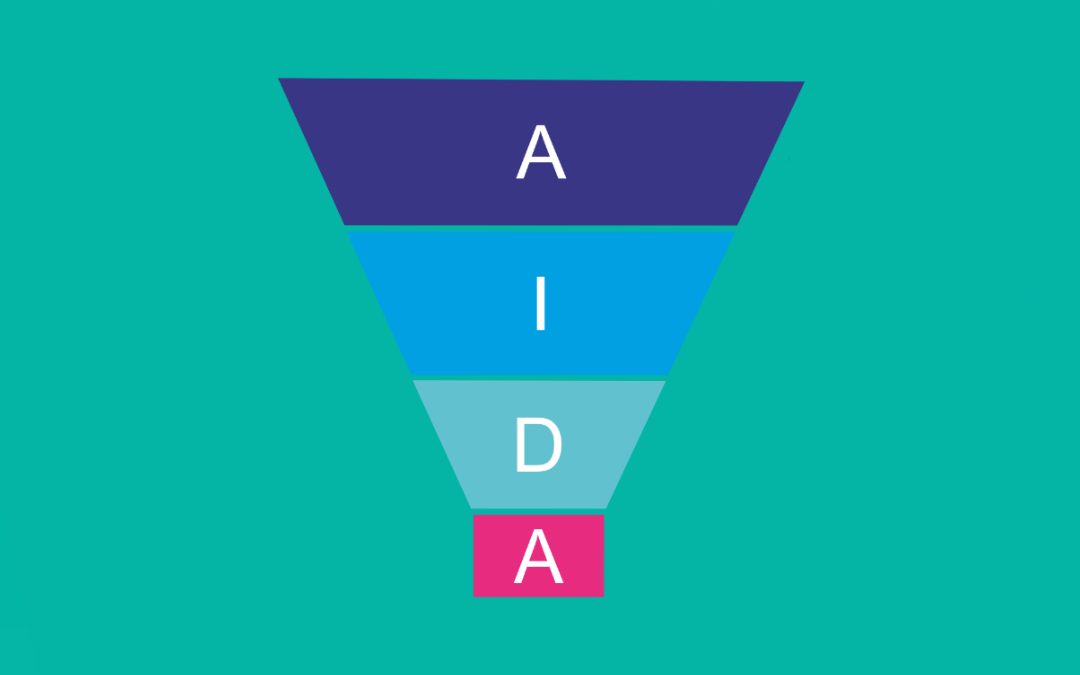
The AIDA model is an acronym that describes the 4 stages of the conversion journey to the act of sale. These are Attention, Interest, Desire and Action. It can be considered as a purchasing funnel through which buyers come and go at each stage, in order to have support during the final purchase. Far from being limited to the mailbox, it can be applied to the writing of any type of commercial message. Its scope of application extends to the composition of effective marketing messages such as the sales page, the newsletter, the landing page, and advertising.

Source: https://www.emarketinghacks.com/
Why implement the AIDA method for your marketing and content?
This model is easy to remember since it materializes the essential steps through which an individual goes to buy a product or service. The steps are to be followed in chronological order one after the previous one for a satisfactory result.
The AIDA method is particularly useful because consumers use different platforms, engage at different touchpoints, and need different information throughout the stages from different sources. Indeed, this communication model (rather than decision-making) will identify for companies how and when to communicate at each stage so as not to offend the target. With this in mind, it is useful to help you plan your tailor-made and targeted communication campaign.
For a good application of this method, it is advisable to follow each of the letters in order. This will help improve your emailing strategy.
“A” for Attention
First, you need to grab the reader’s attention with keywords, a catchy headline, or a striking image. All of this must happen within seconds of receiving your message. If you fail at this first step, the reader may be tempted to move on. To do this, you can use the following techniques: Use a particular font to attract the eye.
- Include surprising information (choose the words carefully).
- Choose a striking image or a color that stands out at first glance.
- Focus on the right keywords.
- Dare to use humor in your messages for a little originality.
- Think in an original and different way for the subject of the email.
“I” for Interest
This part is also delicate since it is in this step that you will give importance to your reader. The email is considered very personal since it allows you to address yourself to a specific person. Therefore, your content must carry a personalized message, and provide an answer to the specific need of the target. In all simplicity and clarity, the recipient must feel that the message is personally addressed to him. Both form and content count a lot in terms of communication. Consider the following points at this stage:
- Present the main features of your offer.
- Use a little storytelling technique (tell a little story).
“D” for Desire
Once you have piqued the reader’s interest, it is vital that you make your offer irresistible to them. Build their desire to own the product, use it, and experience the product. To do this:
- Demonstrate how the offering can solve a problem.
- Play on the emotions felt once the product is purchased.
- Don’t hesitate to mirror the situation before and after purchasing the product, emphasizing the benefits of having it.
“A” for Action
Last but not least, this is the final and essential phase of the AIDA method. After fully supporting a potential client throughout this process, your “call to action” must be powerful enough to transform a desire into concrete action. At this stage, we recommend focusing on:
- Rarity (limited stock).
- Urgency (create the feeling of a last-minute offer).
- The exceptional (attractive price, gift or bonus for any purchase, etc.)

Passionate about the web and entrepreneurship, I founded Digitiz in 2016. My goal is to share my experience with you and save you time in choosing your tools.
Similar articles

![When to post on Instagram? Best moments [MAJ 2022]](https://davidreyero.es/wp-content/uploads/2023/10/instagram-header-768x432.jpg)