
3 simple steps to content that engages and converts your audience
Last modified July 18, 2021
We hear a lot of things about content marketing and there is so much competition today that we no longer know where to turn.
This article aims to refocus you on the 3 simplest and most effective steps to create content that truly engages your audience.
Let’s get back to the basics, the ones that work to redefine an impactful content strategy.
So let’s go !
1. Really know your audience.
Why is it essential?
If there is one area that I strongly recommend working on before launching into content marketing (or afterward, if it is already too late…) it is knowing your audience.
Like many, you will perhaps answer me that you have read it ten times, that yes, you know your audience, but that you do not engage them and that your traffic does not take off.
Here, I would like to try to question some of your certainties:
- Who is your audience? Is it really who you imagine it to be?
- What are his needs? His problems? His frustrations?
- What issues concern her the most?
- What type of content does she like to consume? And or ?
If you don’t have the answers to these questions, chances are your content marketing strategy isn’t giving you the visibility And commitment that you were waiting for.
And that’s normal. You must be able to reach where there is a real need, where you will be indispensable.
Here are some very useful hacks that should help you redefine your audience or your future audience with more certainty.
If you already have an audience of any size:
- Use the data you already have with Google Analytics and Social Media Analytics. Using these tools, you will be able to define basic information such as age groups, gender, but also traffic source, main interests, geographic data, etc. Take advantage of these tools to observe which pages of your site and the publications that most engage your audience to deduce the issues that interest them the most.
- Ask him questions! If you already have an audience, take advantage of it. Launch a questionnaire to better understand their weaknesses, their needs, their frustrations and their interests to better define your next content and your acquisition strategy.
If you don’t have an audience or want to go further:
- Carry out a more in-depth study on the target of your domain by conducting documentary research on your sector and the target you think you want to reach. Existing sociological and market studies can provide you with valuable information about the environment and behaviors of your future audience.
- Customer reviews are a goldmine. Go read your competitors’ reviews, what people are saying about their products and services. It’s one of the quickest and most effective ways to understand what your competitors are missing and what consumers are looking for. Take advantage of it to define relevant content that will stand out against the competition.
It is essential to model all this information ideally within one or more personas. Gather all the essential information and get rid of the rest. The most important being: the key elements according to your market (age, location, family, etc.), needs, frustrations and means of communication (social networks).
2. Give your audience what they are looking for
Once you know your audience more clearly, you’ll be better able to determine which topics will be most engaging.
The idea being to have a complete process and go beyond simple advice, I will share with you some ideas and tools to ensure you always choose the best topics for your content.
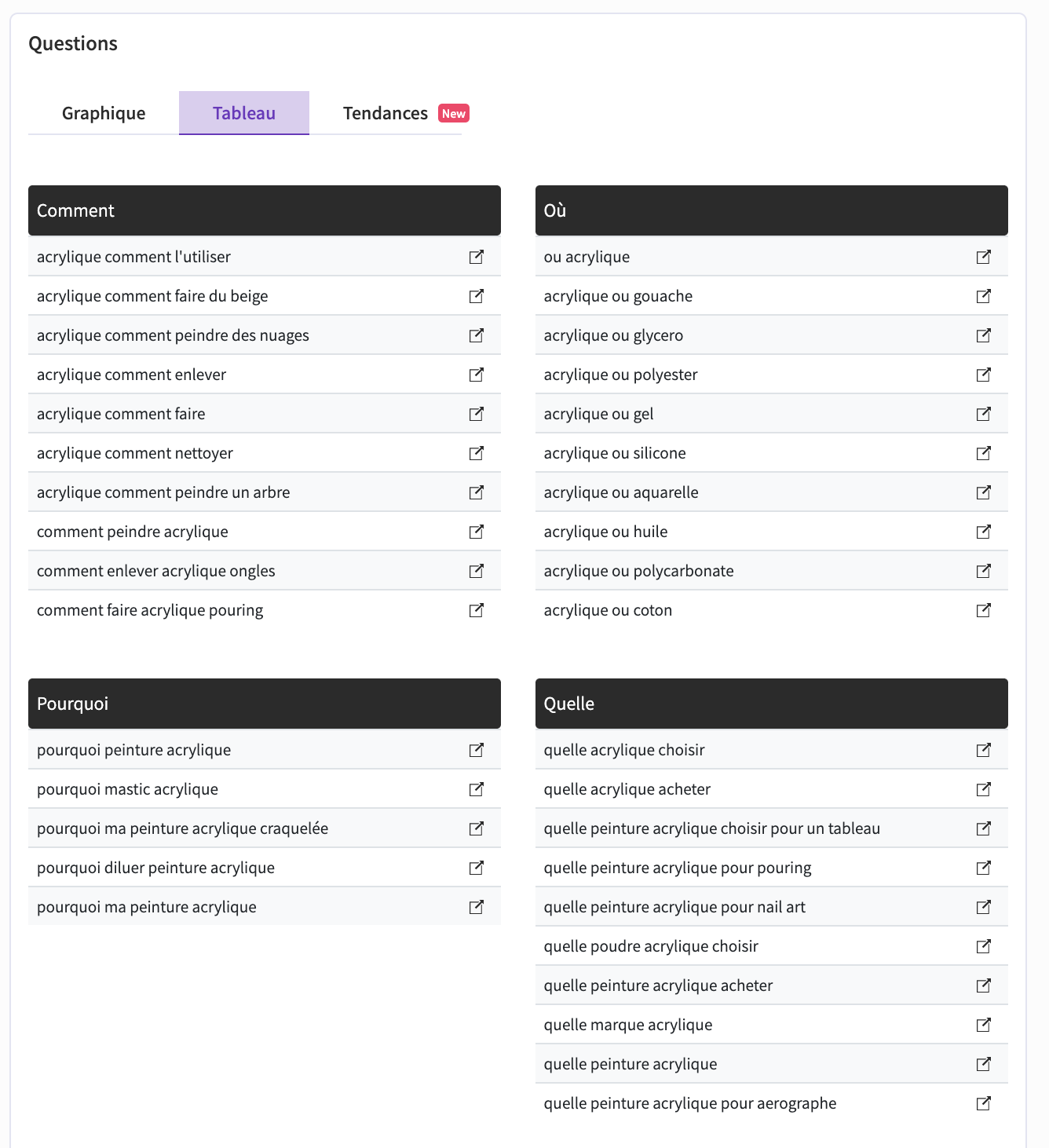
Asking Franklin, to find out Internet users’ requests and trends
Asking Franklin is a tool that allows you to discover what people are asking about keywords in your domain.
You will be able to determine the search intent of your target audience by understanding the precise questions they are asking on X subject.
By establishing a process like this for your content marketing plan, you will not only be able to write about the right topics and make yourself more visible on the SERPs by using the right phrases and the long tail.
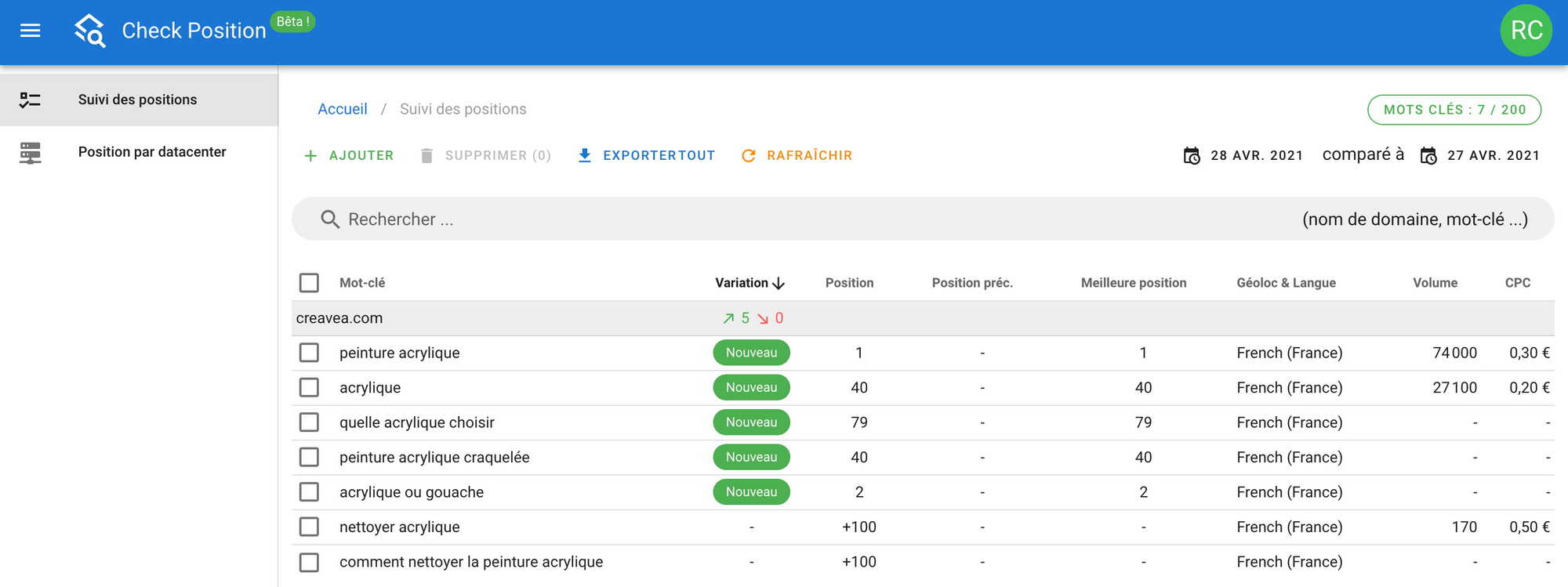
Check Position, to find out the search volumes
Check Position is a free tool that allows you to determine the keyword volumes of your content. A lot of information will be very useful to you in this tool where you can search up to 200 keywords.
In particular, you will be able to know the position of your site on the different keywords selected.
But the most interesting thing is to validate the keywords resulting from user queries on this tool in order to prioritize the most relevant and effective ones on the SERPs.
Know how to respond to your audience’s desires
Finally, know how to respond to your audience’s desires and highlight them in your content. Since you know the questions that your target audience and Internet users are asking, since you have previously carried out research on their frustrations, needs and wishes, you now just need to give them THE answer.
But how can you use this desire to create engaging content?
By following these 3 steps:
- Choose the most burning desire that your product or service satisfies.
- Highlight this desire in your communication. Suggest a way to answer it.
- Ditch the features and talk about benefits to your target. How your product or service meets their desire.
3. Capture your audience’s attention and engage them!
After knowing your audience and their Google searches, their questions and their frustrations, you can now create your content with the certainty of the interest it will arouse among them.
Now all you have to do is create good content. Yes but how ?
Write a hook that works every time
As you can imagine, the title is a determining element since it will determine the click rate of your content. It must therefore arouse real interest in the reader by evoking a problem in which they can identify and which will give them the certainty of finding in your content the answer to their questions, the solution to their problems. It can thus take on an emotional aspect which will touch your target audience even more.
Writing a good hook can therefore be a difficult exercise, but certain structures can help you work better.
- Make a promise (that you keep in the rest of the content)
- Be simple and concise
- Insert powerful words or a key phrase
- Using the “how to” or the “X tips for..” format provides the reader with concrete solutions
- Using the “why” promises a concrete answer
3 examples:
5 tips to quit smoking for good
Here’s why you should definitely give up coffee after midday.
Become a content marketing expert with these 5 simple techniques.
Add emotion to your content
In content marketing, emotion has a central place. This is something that many don’t think about but really elevates your content in the eyes of your audience.
We are humans. Well, not sure if I’m telling you anything there.
We are governed by emotion, whatever it may be, and that is why we are more touched and remember more content that makes us feel something.
In marketing, the aim of working with emotions is to create a bond between you and your audience. To establish a level of trust and proximity.
To do this, here are some tips to apply:
- Humanize your speech with storytelling, tell a story to your audience
- Reach your audience by drawing on the frustrations and needs you have already studied.
- Work on your company values and highlight them in your content
- Write as you speak, avoid too neutral tones and without taking positions
Keep in mind that emotion is a key factor in developing your engagement. The more your audience finds themselves in your content, the more they will consume and share it.
For each product, you sell two.
In terms of your products and services, avoid being too advertising in your content by constantly highlighting them. But when you need to highlight it in a timely and relevant context, keep in mind that you have two products to sell.
- There is the physical product. The nature of your product. An e-commerce site, a web agency, a bottle of bourbon (for reflection)…
- And there is what your product does for the prospect: its benefits, its competitive advantages.
The first provides rational and factual elements. It allows the prospect to project oneself regardless of their level of maturity and knowledge of your product or service.
While the second is the sales stage. Must therefore think about benefits customer and why he would buy from you rather than elsewhere.
You probably know this very well-known video by Simon Sinek “How great leaders inspire action” which explains very well the “WHY” strategy widely used by leaders like Apple.
You will thus understand the whole point of selling the benefit of your product and its value before the product itself.

Passionate about the web and entrepreneurship, I founded Digitiz in 2016. My goal is to pass on my experience to you and to be able to save you time in choosing your tools.
Similar articles